
A plane-side pickup is possible, but it depends on the airport, FBO, aircraft operator, and current security authorization. Private aviation ground transportation may instead begin at an FBO or terminal, where the chauffeur meets passengers after they leave the aircraft.
That distinction matters when arranging a smooth arrival: the aircraft’s landing point, pickup location, and access procedures all shape the handoff. Sharing accurate flight and arrival details helps keep the transportation plan aligned when plans change.
This guide explains how plane-side, FBO, and terminal pickups work, what determines whether a chauffeur can reach the aircraft, and how flight departments and assistants coordinate the details. You’ll also learn what information helps make a pickup in West Palm Beach or Palm Beach County clear, discreet, and well organized.
Key Takeaways
- Plane-side pickup depends on airport and ramp-access procedures; an FBO or terminal meeting point may be the practical alternative.
- Share the flight’s arrival details and update the transportation coordinator promptly if plans change.
- Specify the exact FBO so the chauffeur can plan for the correct pickup location.
- Choose transportation with passenger count and luggage in mind to make the transfer comfortable and orderly.
- Coordinate the pickup plan among the passenger, assistant, flight department, and chauffeur before arrival.
What is private aviation ground transportation?
Private aviation ground transportation connects a private flight with onward travel by chauffeured vehicle, rental car, or rideshare. Depending on airport access and arrival arrangements, the pickup may be at an FBO, terminal, or aircraft. A clear plan links the meeting point, passenger needs, and destination.
Vehicle Options for Passenger and Luggage Needs
Match the vehicle to both the passenger count and luggage load. A sedan may suit a solo traveler with a carry-on, while an SUV can accommodate a party traveling with full-size bags. A sprinter may suit a larger group, depending on the specific vehicle and luggage space.
Share the passenger count, number of bags, and any oversized items before booking. Golf clubs or several hard-sided cases can affect which vehicle fits comfortably. Rental cars give travelers a vehicle to drive, while rideshares use their available pickup process. Chauffeured service pairs the ride with a prearranged pickup, similar to reserving an airport transfer through fleetminicabs.com to ensure the vehicle matches your party and luggage requirements.
There is no single average cost for private aviation ground transportation across the United States. The quote depends on the route, vehicle, and requested service, so a nationwide average would not describe an individual trip.
Aircraft-to-Vehicle Transfer Coordination
A direct transfer takes passengers from the aircraft to a vehicle at or near the ramp, rather than to a public terminal pickup point. The airport, FBO, operator, and current security authorization determine whether that handoff is permitted.
Some FBOs use flight-tracking technology to prepare a vehicle for an arriving aircraft. Flight departments or coordinators can share revised arrival details promptly. A tail number, the unique registration displayed on an aircraft’s tail, can help identify the flight. Operators or flight coordinators usually confirm it a few hours before departure.
Discreet Transfer Arrangements
Discreet arrangements establish a clear handoff while limiting unnecessary sharing of passenger details. For example, an assistant can provide the chauffeur with the meeting point, vehicle description, and a contact for updates.
Passengers should consider practical risks such as a mistaken vehicle match, unclear instructions, or attempted ramp entry without authorization. The chauffeur should follow airport access procedures and meet passengers only at the designated location. A private aviation ground transportation plan should specify the pickup point and how the passenger will identify the vehicle.
Airport Services and Provider Credentials
No single US airport is best for every traveler. The right option depends on the itinerary, airport location, FBO, and onward destination. For travel to West Palm Beach, those details shape which arrival facility and pickup arrangement make sense.
Licensing and insurance requirements vary by operation and jurisdiction. Consider whether the provider has applicable commercial passenger-transport credentials and insurance documentation. Safety and security considerations include vehicle identification, passenger privacy, and authorized airport access.
For private aviation ground transportation, confirm that the booking reflects the correct flight, pickup facility, passenger needs, and destination. These practical details help align the vehicle arrangement with the trip.
Coordination with flight departments and assistants
A coordinated pickup starts with one reliable itinerary shared among the passenger, assistant, flight department, and chauffeur. Each update should identify the flight, arrival airport, FBO, passenger count, destination, and person handling changes.
Align the Transportation Plan With the Flight
Charter, corporate flight department, and fractional travel may involve different coordinators. An assistant can arrange the car while the flight department or charter operator confirms aircraft details. For fractional travel, identify the contact responsible for the specific flight. This keeps the pickup plan connected to the people who can communicate schedule changes.
Provide the planned arrival time, airport, exact FBO name, passenger names, and destination. Include luggage needs and a working contact number for the travel coordinator. An airport may have several FBOs, so the airport name alone can leave the meeting point unclear. The reservation should also state whether the car is needed after arrival or for a later departure.
Share Updates and Flight Details
The aircraft’s tail number is usually confirmed by the operator or flight coordinator a few hours before departure. Share it with the transportation contact once available, along with the passenger itinerary. Tail-number tracking and direct coordination with the flight crew or charter operator can help monitor private and charter flights. Tracking does not replace clear communication about the pickup point.
If the arrival time, aircraft, airport, or FBO changes, share the revision as soon as it becomes available. Updated arrival information helps keep the plan current. For example, if a flight diverts to another airport, the assistant should relay the new airport and FBO, not just a revised arrival time.
Coordinate Staging and Passenger Handoff
Schedule vehicle staging around the latest flight information and agreed meeting location. The chauffeur needs clear instructions on where to wait, how the passenger will identify the vehicle, and whom to contact if the aircraft lands at a different FBO. The flight department can relay operational updates while the assistant keeps passenger arrangements and the onward itinerary aligned.
Settle the handoff details before departure. Decide whether the passenger will meet the chauffeur at an FBO entrance, terminal curb, or another authorized location. If ramp access is part of the plan, airport and FBO procedures determine whether the vehicle can reach the aircraft. The chauffeur should not assume access based only on the flight schedule.
For a group traveling together, confirm who is onboard and whether anyone will leave separately. The assistant can share separate destinations or departure plans directly, reducing confusion after landing. One coordinator and one current itinerary help the chauffeur respond to changes without conflicting messages.
Can the chauffeur pick up plane-side?
Sometimes, but plane-side pickup is not available at every airport or FBO. Access depends on the airport, FBO, aircraft operator, and current security authorization. Dispatch should confirm the approved meeting point and arrange the vehicle accordingly. If ramp access is unavailable, passengers can meet the chauffeur at the FBO or terminal instead.
For international arrivals, coordinate transportation timing and the meeting location with the airport’s customs-arrival process. The chauffeur meets passengers at the designated pickup area once they are ready to continue, rather than treating the aircraft ramp as a public meeting point. The same principles apply for travelers landing abroad; for instance, coordinating regional transfers with services like GATE.taxi in the UK requires sharing accurate flight and customs details to ensure a seamless arrival.
What Determines Ramp Access?
An airport’s access procedures determine whether a vehicle may enter the ramp. The FBO and aircraft operator also affect the arrangement, including where a chauffeur may wait and whether passengers can be met beside the aircraft. A landing time alone does not establish permission to enter.
Before dispatch, the transportation coordinator can align the airport, FBO, aircraft arrival, and pickup instructions. If the FBO changes, the meeting location and access plan may need to change too. Clear details help prevent the chauffeur from waiting at a terminal while passengers exit elsewhere.
What Happens on Arrival?
For an aircraft-side pickup, the vehicle must be directed to an authorized location. The chauffeur follows airport and FBO instructions and meets passengers only where access is permitted. If the aircraft parks away from the approved vehicle area, passengers may need to walk to the FBO or another designated handoff point.
The distinction matters for comfort and luggage. A close ramp handoff can reduce walking, while an FBO pickup may involve moving bags through the facility. The destination, passenger mobility, and luggage load can help determine which meeting point works best.
Can the Chauffeur Reach the Aircraft for a Return Trip?
Return-trip access follows its own airport procedures. Whether a driver may accompany passengers to their aircraft depends on the airport’s current authorization process and the arrangements made with the FBO or aircraft operator. Confirm these details before the departure rather than assuming ramp access is permitted.
Plan the return pickup with the aircraft operator or FBO, not just around the departure time. The chauffeur needs the correct airport entrance, meeting point, and instructions for reaching the aircraft. If ramp access is unavailable, an FBO handoff can connect the ground ride with the departure without assuming tarmac entry.
For travel to West Palm Beach, the practical question is where the airport and FBO authorize the handoff. A clear dispatch plan identifies the destination, arrival point, and permitted access route before the vehicle is sent. Passengers then have a clear next step, whether the chauffeur meets them plane-side or at an approved facility.
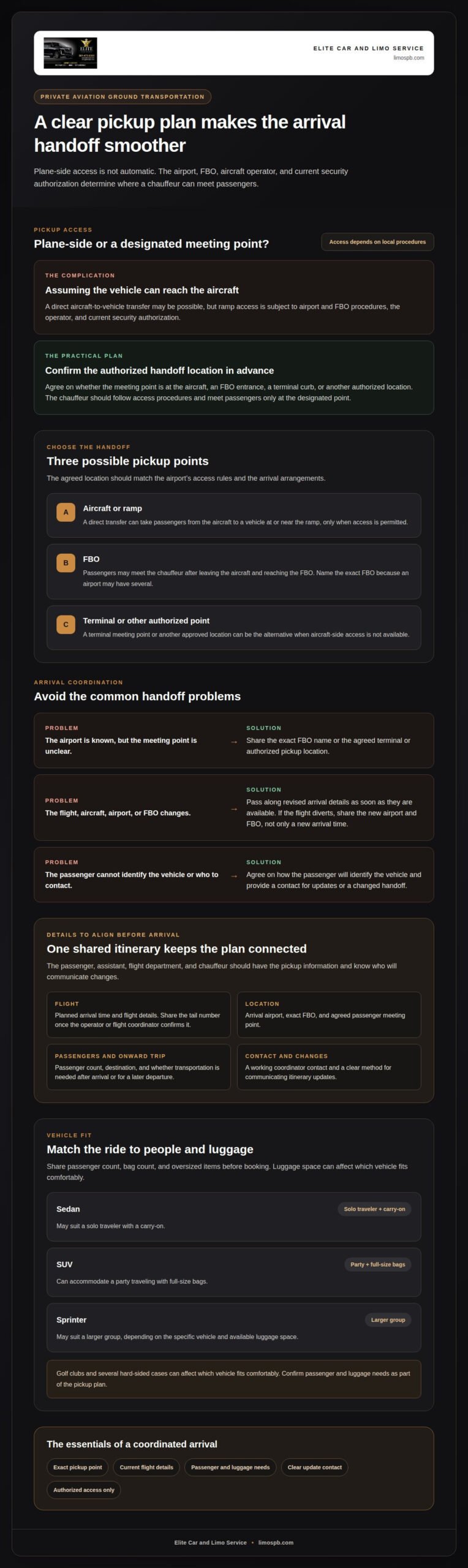
FBO, terminal, and aircraft-side pickups
The meeting point shapes how passengers move from arrival to their waiting vehicle. An exact FBO name, terminal location, or approved aircraft-side handoff gives the operator a clear pickup plan.
FBO Plane-Side Pickups
An FBO pickup may take place inside the facility or, where access permits, near the aircraft. Because an airport can have several FBOs, give the operator the exact facility name, not just the airport. At West Palm Beach-area airports, that detail identifies the intended arrival point and keeps the chauffeur’s instructions specific.
Plane-side access depends on the airport, FBO, aircraft operator, and current security authorization. A passenger’s preference alone does not establish ramp access. The pickup plan should name the permitted meeting point and account for luggage, passenger mobility, and onward destination. If the vehicle cannot reach the aircraft, the FBO can provide the handoff location.
Terminal and Aircraft-Side Pickups
A terminal pickup directs passengers to a designated curb or meeting area after they leave the aircraft and complete airport procedures. An aircraft-side pickup brings the vehicle closer, but only when airport and operator procedures allow it. For international arrivals, the meeting plan should account for the required arrival process before passengers proceed to transportation.
For example, an assistant can send the chauffeur the airport, exact FBO or terminal, flight details, and destination. If the aircraft parks at a different facility, the operator can update dispatch before the vehicle is sent to the original location. These details reduce confusion and unnecessary waiting.
Flight tracking can help coordinate a vehicle’s timing with an aircraft’s arrival, but it does not determine where a chauffeur may wait. The operator and airport access procedures determine that location. Arrival updates should include both timing and facility changes, especially when a flight diverts or changes FBO.
A useful pickup confirmation includes four practical details: the airport, exact FBO or terminal, passenger handoff point, and destination. Include a contact for updates. If the plan calls for aircraft-side service, state that clearly so dispatch can coordinate authorized access rather than assume a curbside pickup.
In Palm Beach County, the right arrangement depends on the airport and private aviation facility handling the flight. A sedan may suit a passenger with limited luggage, while a larger vehicle may better accommodate a group or more bags. Choosing the pickup point and vehicle together helps the operator plan around the arrival, not simply the flight’s scheduled time.
For departures, agree on whether the chauffeur will meet passengers at the FBO or another approved point. An aircraft-side drop-off may be possible where airport procedures permit it. Clear instructions for the operator, passengers, and flight coordinator keep the meeting plan aligned if the aircraft or FBO changes.
Private aviation and jet charter ground transportation
Private aviation ground transportation connects a private flight with onward travel by chauffeured vehicle. For charter passengers, the ride is separate from the aircraft booking. An executive assistant, corporate travel coordinator, or flight department can arrange the car around the itinerary, arrival facility, passenger count, and destination.
Coordination needs differ by trip. A charter passenger may rely on an operator to provide updated arrival details, while a corporate flight department may manage aircraft and traveler schedules directly. Fractional travel can involve a separate trip coordinator. In each case, the transportation booking should identify who will send changes and who will receive pickup instructions.
For a business meeting in Palm Beach County, connect the arrival location with the meeting address and schedule. A traveler landing near West Palm Beach may continue to an office, hotel, or residence. Each destination affects the route and vehicle schedule. If the itinerary includes multiple stops, list them in order when booking.
Before reserving transportation, the assistant or traveler can provide these trip details:
- Arrival airport and exact FBO or terminal
- Flight arrival information and the coordinator’s contact details
- Passenger count, luggage needs, and any separate destinations
- Pickup location, onward destination, and meeting schedule
- Return-trip details, if transportation is needed for departure
These details help distinguish a simple airport transfer from an itinerary with several corporate stops. An executive traveling alone to one meeting has different vehicle and routing needs from colleagues arriving together with luggage. Choose a vehicle that fits both passengers and bags, and provide the planned stop sequence so the chauffeur can follow the itinerary.
Arrival changes can affect the ground plan, especially when a charter operator revises the aircraft’s timing or arrival facility. The flight coordinator or assistant should send updates as soon as they become available. If the FBO changes, update the pickup location in the transportation instructions too. Flight information helps coordinate timing, while the exact handoff point tells the chauffeur where passengers will meet the vehicle.
For corporate travel, one contact should manage the current itinerary and relay changes to the transportation coordinator. That approach reduces conflicting instructions when a passenger, assistant, and flight department are communicating separately. In West Palm Beach and Palm Beach County, a well-organized booking can link a private-flight arrival with airport transfer or onward business travel. Arrange private aviation transportation around the flight, pickup point, and destination.
Elite Car and Limo Service: Private Aviation Services
Elite car and limo service provides private aviation services for travelers arranging chauffeured transportation to or from a private flight. An airport transfer can connect an FBO arrival with a hotel, residence, or meeting in West Palm Beach and Palm Beach County. For executive itineraries, corporate transportation for your business and business travel can support planned rides beyond the airport transfer.
Share the arrival facility, pickup location, passenger and luggage needs, and onward destination when arranging transportation. These details help shape a suitable reservation and keep the ground itinerary aligned with the flight plan.
Contact Elite car and limo service to discuss your private aviation transportation.
Plan Your Next Ground Connection
Treat the vehicle reservation as part of the travel itinerary. For an upcoming arrival or departure, identify the passenger’s onward destination and who will coordinate updates if flight plans change. This gives the transportation arrangement a clear purpose, whether the priority is a private residence, business meeting, or airport connection.
Elite Car and Limo Service offers Private Aviation Services, Airport Transfer, and Corporate Transportation For Your Business in West Palm Beach and Palm Beach County. Share your trip details and destination to arrange transportation suited to your itinerary.
Thoughtful private aviation ground transportation can make the transition from aircraft to onward travel feel more considered. Contact Elite Car and Limo Service to discuss your transportation plans and take the next step with confidence.
Frequently Asked Questions
How early does the chauffeur arrive?
The chauffeur’s arrival is scheduled around the pickup time set for your reservation. For a private flight, provide the expected arrival window and FBO, then share schedule changes promptly. If passengers need time to collect luggage or complete airport arrival procedures, include that in the plan. This helps coordinate dispatch with the intended handoff rather than relying only on the flight’s scheduled arrival.
What ground transportation options are available for private aviation passengers?
Private aviation passengers can arrange chauffeured transportation in a sedan, SUV, stretch limousine, or group limousine. Elite Car and Limo Service lists limousines for groups of 10 or 18 passengers. Choose based on the number of travelers, luggage, and destination. For example, a small executive party heading to a meeting may prefer a sedan, while a larger group may need more passenger space.
How do private jet ground transportation services work from FBO to destination?
A chauffeur-driven transfer connects an FBO pickup with an onward destination, such as a hotel, residence, or business meeting. Arrange private aviation ground transportation with the FBO name, passenger count, luggage details, and destination included in the itinerary. In the West Palm Beach area, sharing the full destination helps plan the ride beyond the airport handoff.
How do I book a chauffeur, SUV, or limousine for a private flight?
Contact Elite Car and Limo Service by calling (561) 475-6365 or emailing info@limospb.com to arrange a reservation. Include your airport, FBO, flight information, requested pickup time, destination, passenger count, and luggage needs. If you have a vehicle preference, mention it with the trip details. The reservation can then be planned around the journey rather than just the aircraft arrival.
Can ground transportation be coordinated with a private jet flight itinerary?
Yes. Share the itinerary and designate an assistant or travel coordinator to relay changes to the transportation team. Elite Car and Limo Service monitors flight arrivals and departures in real time, helping coordinate pickups as schedules change. For a trip with several stops, include each destination and its sequence so the ground itinerary reflects the traveler’s plans.