
A funeral procession depends on more than a polished vehicle. A funeral limo service should support composed, punctual travel and follow the family’s itinerary with care, including coordination with the funeral director. The chauffeur’s discretion and attention to timing matter as much as the ride itself.
It’s understandable to want reassurance that the person behind the wheel will handle a sensitive occasion professionally. Rather than relying on a vague promise of “special training,” look for clear coordination: pickup details, destinations, procession order, and a day-of contact should be aligned in advance. A written itinerary shared with the family and transportation company helps everyone work from the same plan.
This guide explains how transportation can support family members across service locations, what to coordinate with the funeral director, when to arrange the booking, and how dispatch and multi-vehicle processions are organized. You’ll also learn what details to settle ahead of time, so travel feels orderly and the family can focus on being together.
Key Takeaways
- Plan family transportation around the full itinerary, including service locations, passenger needs, and cemetery timing.
- A written schedule shared with the family and funeral director helps align pickups, routes, and vehicle staging.
- Clear day-of communication gives the chauffeur and funeral director a practical way to coordinate timing and changes.
- For a multi-vehicle procession, set the vehicle order and route in advance so each driver understands their place.
- Families arranging transportation in Palm Beach County can contact Elite Car and Limo Service to discuss their needs.
Transportation for family members
Family transportation can connect the funeral home, service venue, cemetery, and gathering afterward. A written itinerary helps relatives follow the planned pickups and destinations.
Funeral and Celebration-of-Life Travel
A funeral and a celebration of life may call for different travel plans. A formal service may involve a funeral home, place of worship, and cemetery, while a celebration may end at a private venue. The booking should reflect the actual schedule, passenger needs, and stops. For example, include the reception location if guests will travel there after the service.
Family members, close relatives, pallbearers, and elderly guests may have different pickup needs. A funeral limo service can be arranged around the family’s chosen gathering points and itinerary. Identify who needs transportation, where each person will board, and whether anyone needs extra time to enter or exit the vehicle.
Families should confirm that transportation is properly authorized and insured, and that passengers can travel safely in the selected vehicle. Requirements vary by operator, vehicle, and applicable local and state rules.
Travel Between Funeral Locations
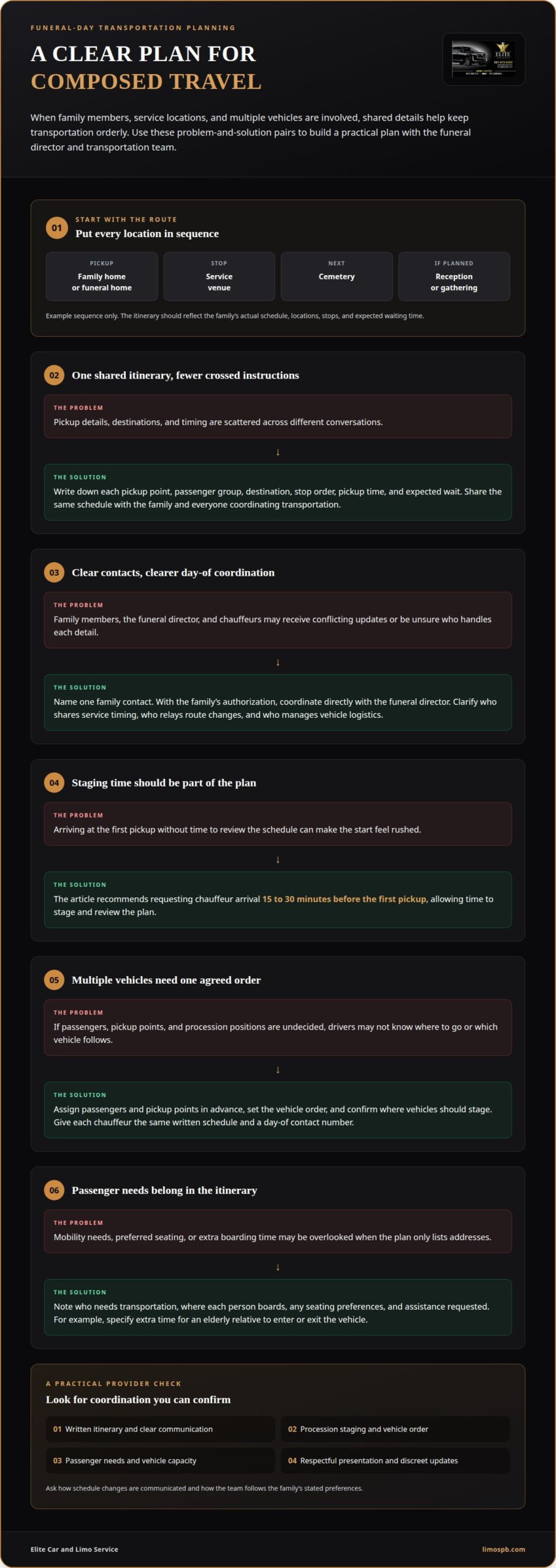
Yes. Funeral transportation can take family members between the funeral home, service, and cemetery, with additional stops included in the itinerary. Provide each location, pickup time, and expected waiting period so the driver’s schedule reflects the full route, not just the first destination.
A typical itinerary might begin with pickups at a family home or funeral home, continue to a service, then proceed to the cemetery. A reception or wake may follow. Booking duration depends on the route, number of stops, service timing, and waiting time. Review the booking terms for the scheduled period and how additional time is handled.
In West Palm Beach and nearby Palm Beach County communities, list every address and stop in order, especially when relatives are traveling from separate locations. A route might connect a funeral home, service venue, cemetery, and gathering place. The distance between venues and the schedule shape the transportation plan.
For multiple vehicles, assign passengers and pickup points before the service day. One vehicle might carry immediate family, while another transports relatives or pallbearers. Share the same written schedule with everyone coordinating the trip, and include a day-of contact number. This gives the group a clear reference if a stop or pickup changes.
For example, if relatives are gathering at different homes, record each pickup address and passenger group in the itinerary. Include the correct sequence for the funeral home, service venue, and cemetery. These details help the transportation team plan the route and clarify where passengers should meet.
Families can also note mobility needs, preferred seating arrangements, and the assistance passengers may want. A specific note, such as allowing extra boarding time for an elderly relative, gives the chauffeur useful direction without requiring the family to manage every detail on the day.
Can you coordinate with the funeral director directly?
Yes. Transportation arrangements can be coordinated directly with the funeral director when the family authorizes communication and shares the necessary details. A written itinerary gives the director and transportation team one schedule for pickups, locations, and procession order.
For example, the director can confirm when the service ends and where vehicles should stage afterward. The transportation coordinator can relay pickup instructions, route changes, and timing updates to chauffeurs. Chauffeurs are requested to arrive 15 to 30 minutes before the first pickup, allowing time to stage and review the plan.
Direct coordination also clarifies responsibilities. The family may identify one relative as its contact, while the funeral director manages service timing and the transportation coordinator handles vehicle logistics. This structure helps prevent conflicting instructions during an emotional day.
What should you compare when choosing a funeral transportation provider? Compare how it handles communication with the funeral director, written itineraries, procession staging, passenger needs, and schedule changes. Also consider vehicle capacity, the chauffeur’s presentation, and how the provider communicates discreetly with the immediate family.
Support should be attentive without becoming intrusive. For instance, a chauffeur can offer help with a vehicle door or explain where the next pickup will take place, while allowing relatives to decline assistance. Clear instructions about mobility needs, seating, and family preferences help guide appropriate service.
- Communication: Set one day-of contact and share the director’s relevant timing updates.
- Itinerary: Record pickup points, destinations, stop order, and any scheduled waiting.
- Presentation: Agree on formal attire, discreet conversation, and respectful conduct.
- Procession: Confirm where vehicles stage and how chauffeurs receive the order.
These details offer a more useful measure of funeral experience than an unsupported claim about special training. Ask how the team follows the written plan, communicates changes, and respects the family’s preferences. In Palm Beach County, a route involving a funeral home, service venue, and cemetery needs the same careful coordination as any multi-stop itinerary.
For a Palm Beach County arrangement, review the funeral transportation information while organizing the schedule and communication plan.
Coordination with funeral directors
A shared schedule lets the funeral director and transportation coordinator manage separate responsibilities without giving relatives conflicting instructions. It should identify the service location, pickup points, destination order, and the person authorized to communicate changes.
For example, the funeral director can advise when the service is expected to conclude, while the transportation coordinator relays departure instructions to each driver. The family can designate one contact for personal requests. This division keeps logistics organized and limits interruptions during a solemn occasion.
Use one written itinerary as the working reference. Include the funeral home’s name, each address, pickup sequence, vehicle assignments, and destination after the service. If the schedule includes a cemetery and reception, list both stops in order. Clear details help the driver understand the planned route and give the director a concise way to confirm timing.
Pickup coordination begins with the exact meeting point. A funeral home may have several entrances, parking areas, or adjacent buildings. The itinerary should say whether relatives will board at the main entrance or another designated location. For a private residence, include a recognizable landmark or a specific place to wait.
Drop-off instructions deserve equal care. At a service venue, identify where passengers should exit and where the vehicle should wait afterward. At a cemetery, the director can clarify the intended arrival sequence and vehicle staging area. These details help drivers avoid blocking entrances or separating relatives from the procession.
For multiple vehicles, establish procession order before departure. The director or designated coordinator can identify which vehicle leads, where family vehicles follow, and where other passengers belong. Drivers then receive consistent instructions instead of relying on informal signals from relatives. If the route changes, the designated contact can communicate the update to the group.
A respectful plan also accounts for the family’s preferred level of interaction. Some relatives may appreciate a brief explanation before boarding; others may prefer quiet. The transportation coordinator can note these preferences alongside practical needs, such as a passenger requiring extra time to enter the vehicle. This lets chauffeurs offer considerate assistance without drawing unnecessary attention.
Elegant presentation should support the occasion, not distract from it. Families can communicate expectations for formal attire, discreet conversation, and calm driving before the service. A professional driver follows those instructions while remaining attentive to the schedule and the funeral home’s guidance.
Before the day, the coordinator can share the final itinerary with the funeral director and relevant drivers, then identify one contact for updates. This gives each participant a clear role: the director manages service logistics, the coordinator relays transportation details, and relatives can focus on being present.
Booking timelines and 24-hour dispatch
Booking early gives the transportation coordinator time to organize the route, vehicles, and pickup sequence. Short-notice arrangements can be more difficult when a funeral date, service time, or location changes quickly. The practical priority is to share confirmed details as soon as they’re available, then communicate updates through one designated contact.
Advance reservations are especially useful when the itinerary includes several locations or relatives arriving from different areas. For example, a Palm Beach County schedule might include a family pickup, funeral home, service venue, cemetery, and gathering afterward. Sharing that sequence early allows the coordinator to plan each leg and identify details that still need to be settled, such as the service’s departure time.
Short-notice bookings call for a clear order of decisions. First, establish the confirmed service time and primary pickup location. Next, provide the complete route and passenger count. Then identify any open details, such as the cemetery’s arrival instructions or the reception location. This sequence gives the transportation team the information needed to assess the trip and organize dispatch without relying on assumptions.
The phrase “24-hour dispatch” describes the hours a dispatch operation can receive or route requests. It does not, by itself, mean a vehicle is instantly available or that every booking can be accepted. For a family, the useful distinction is between dispatch communication and a reserved trip: the reservation should state the agreed pickup time, itinerary, and day-of contact method.
Once arrangements are made, keep updates concise and specific. If the funeral home changes the service departure time, the designated contact can send the new time and affected stop to the transportation coordinator. If a relative’s pickup changes, share the revised address and passenger name together. One current itinerary reduces conflicting messages among family members, the director, and drivers.
Advance planning can also account for the emotional demands on the family. Assigning one relative or representative to handle transportation details lets loved ones focus on the service. For a difficult, time-sensitive arrangement, send confirmed information first and clearly mark pending details, so the schedule can be refined without confusing an early draft with the final plan.
Funeral processions with multiple vehicles
A multi-vehicle procession needs a defined order, clear roles, and one shared route. Assign passengers by household or relationship, then match each group to a vehicle before the service. For example, immediate family can travel together while other relatives follow in a separate car. A written sequence helps professional chauffeurs understand where each vehicle belongs.
Available passenger vehicles include sedans, stretch limousines, 10-passenger limousines, and 18-passenger limousines. A 10-passenger or 18-passenger limousine can carry family groups, while a sedan or stretch limousine may suit a smaller party. Capacity should guide assignments alongside comfort, mobility needs, and whether passengers want to travel together.
A hearse serves a different purpose from a passenger limousine: it transports the casket, not a group of relatives. Its capacity therefore isn’t comparable to a limousine’s passenger capacity. A procession plan can place the hearse at the front, followed by vehicles carrying family members and guests.
Wheelchair access depends on the vehicle’s entry, cabin layout, and ability to accommodate mobility equipment. Don’t assume a standard sedan or stretch limousine is wheelchair accessible. For a passenger using a wheelchair, account for boarding, securement, transfer needs, and space for the mobility device when assigning vehicles.
Vehicle condition contributes to a dignified arrival. Before departure, inspect the interior, check doors and seating, and remove debris. Routine cleaning should cover passenger touchpoints and visible surfaces. These steps support a composed experience for relatives, especially when several vehicles arrive together.
Comfort also depends on matching the trip to the passenger group. A larger limousine can keep relatives together, while separate vehicles can accommodate different pickup locations. For example, assign one car to passengers leaving from the funeral home and another to relatives meeting at the service venue. Keep the vehicle order consistent through each planned stop.
- Set the order: Identify the lead vehicle, passenger cars, and each group’s assigned ride.
- Share the route: Give every chauffeur the same destination sequence and staging instructions.
- Plan for access: Match each passenger’s mobility needs to the vehicle’s entry and seating.
- Prepare the vehicles: Include an interior inspection and routine cleaning before pickup.
For a coordinated family procession, request funeral transportation with the passenger groups, route, and vehicle order in mind.
Elite Car and Limo Service: Private Aviation Services
Elite car and limo service provides private aviation ground transportation in West Palm Beach and Palm Beach County. Share your itinerary and pickup details to help organize travel around your schedule.
For relatives traveling separately, Airport Transfer can connect arrivals with local plans. Private Aviation Services and Corporate Transportation For Your Business also support private aviation ground transportation and business travel. Each service addresses different travel needs, with pickup and destination details guiding the arrangements.
If you’re planning private aviation or related travel, contact Elite car and limo service to discuss your arrangements.
Make the Next Journey Easier to Arrange
A carefully planned ride can give family members more space to be present with one another. As you finalize arrangements, consider who will manage transportation updates and how guests will travel between the service and their next destination. Airport transportation may be part of a broader travel plan for relatives arriving in Palm Beach County.
Elite Car and Limo Service provides Airport Transfer, Private Aviation Services, and Corporate Transportation For Your Business. These options serve different travel needs, from airport arrivals to private aviation and business journeys. Keep each request focused on its passengers, itinerary, and timing.
When you’re ready to discuss arrangements, contact Elite Car and Limo Service. A clear starting plan can help make the next steps feel more manageable.
Frequently Asked Questions
Are your chauffeurs appropriately trained for funerals?
Professional chauffeurs provide transportation, and families can communicate service expectations in advance. For example, specify formal attire, minimal conversation, or assistance entering and exiting the vehicle. A written schedule and designated family contact help the chauffeur follow instructions. Ask how the team handles procession logistics and communicates changes, rather than assuming a particular funeral-specific training credential.
Can I book same-day?
You can submit a same-day transportation request, but scheduling depends on the requested time, route, vehicle, and chauffeur availability. Provide the service location, pickup address, passenger count, and destination details together. If the service time or route is still changing, share confirmed information first. Send updates through one family contact to keep the transportation details consistent.
Is the cost different from standard limo service?
The cost depends on the trip and is provided after a quote request. Funeral transportation may involve several stops, waiting time, multiple vehicles, or a longer booking period. These details affect the quote. Compare the itinerary and scheduled time included in the quote, rather than judging by vehicle category alone. A simple point-to-point ride and a multi-stop arrangement have different requirements.
What is included in funeral transportation?
A funeral limo service can include a professional chauffeur and scheduled travel between locations in the itinerary. The route may connect a family pickup, funeral home, service venue, cemetery, or gathering afterward. The booking details should identify passenger groups, vehicle assignments, timing, and planned stops. A hearse transports the casket, while passenger limousines carry family members and guests.
How much does funeral limousine service cost in the United States?
There isn’t one nationwide price that applies to every funeral limousine booking. A quote depends on factors such as location, route, vehicle selection, number of vehicles, stops, and scheduled time. For transportation in West Palm Beach or Palm Beach County, provide the planned itinerary when requesting a quote. This helps the transportation provider assess the specific trip rather than relying on a general estimate.
How do I arrange transportation, and how far in advance?
Share the service date, pickup and destination addresses, passenger count, and vehicle preferences. Include the funeral home’s contact details if the family authorizes coordination. Arrange the ride as soon as the schedule is known, particularly if relatives need separate pickups or vehicles. There is no single advance-booking period for every service, since timing depends on the itinerary and arrangements.
How can I find funeral limo services near me?
For travel in West Palm Beach and Palm Beach County, look for a provider serving the pickup and destination locations and able to accommodate the itinerary. Consider whether your plan requires one passenger vehicle, multiple cars, or travel between venues. Contact Elite Car and Limo Service to ask whether this transportation is available for your trip. Share the route and passenger needs to request a trip-specific quote.