
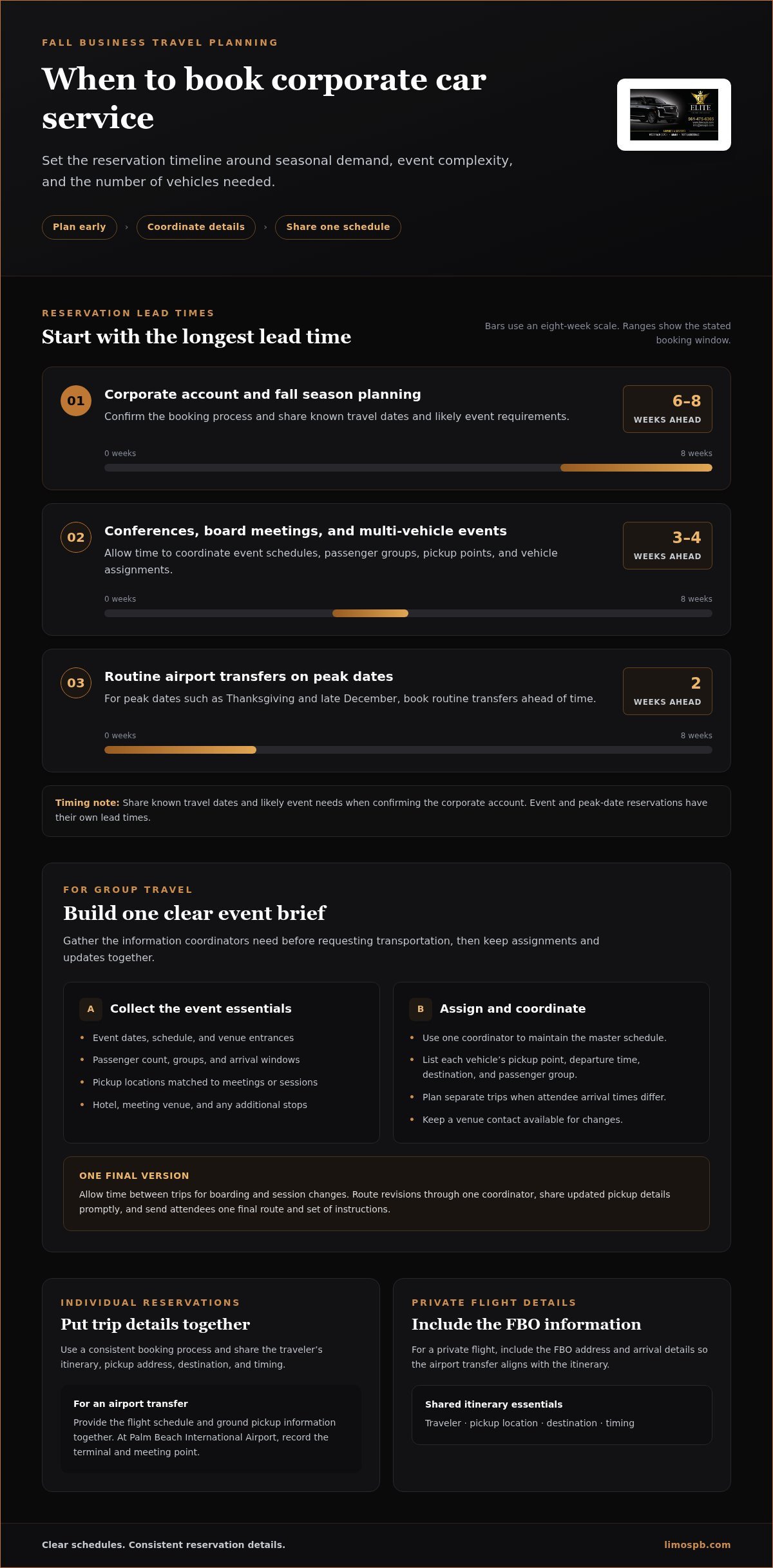
Fall transportation planning should begin six to eight weeks before the season. This gives companies time to confirm their booking process and share known travel dates. For conferences, board meetings, and multi-vehicle events, arrange transportation three to four weeks ahead. Book routine airport transfers on peak dates such as Thanksgiving two weeks ahead. A clear corporate transportation booking process gives coordinators time to align schedules, passenger needs, and pickup details.
Executive travel is easier to manage when reservations, itinerary updates, and group requirements follow a consistent workflow. The right process depends on how often employees travel, how many trips the company coordinates, and how much oversight it needs.
This guide explains when to reserve fall car service, what can affect corporate rates, and how to organize group bookings. It also covers reservation details, itinerary changes, and cancellation terms to review before travel, helping coordinators plan each ride with greater clarity.
Key Takeaways
- Match reservation timing to seasonal demand, event complexity, and the number of vehicles needed.
- Set clear booking procedures and use consolidated records to make corporate travel spending easier to review.
- Share passenger, pickup, and itinerary details early to support smoother coordination.
- Understand how changes and cancellations are handled before confirming a reservation.
- For group travel, organize passenger counts, schedules, and pickup locations before requesting a quote.
How far in advance should companies book corporate car service for fall travel?
For fall business travel, establish or confirm the corporate transportation account six to eight weeks before the season. Share known travel dates and likely event requirements at the same time. For routine airport transfers on peak dates, including Thanksgiving and late December, book two weeks ahead. Reserve transportation for conferences, board meetings, and multi-vehicle events three to four weeks ahead.
Companies can organize employee transportation by setting an approved reservation process and sharing each traveler’s itinerary, pickup address, destination, and timing. A coordinator can collect these details and submit the request through the chosen channel. For a business trip to Palm Beach International Airport, for example, provide the flight schedule and ground pickup information together.
Conference and corporate event transportation requires more coordination than a single airport ride. Start with the event schedule, venue entrances, passenger count, and arrival windows. Match each pickup location to the relevant meeting or session. If attendees arrive at different times, plan separate trips rather than assuming one vehicle movement will suit everyone.
For a multi-vehicle event, assign one coordinator to maintain the master schedule. List each vehicle’s pickup point, departure time, destination, and passenger group. Keep a venue contact available to communicate changes. For a board meeting with separate hotel pickups, clear assignments help guests know where to meet and give drivers consistent instructions.
Conference transportation also benefits from a defined route plan. Identify the hotel, meeting venue, and any additional stops before sharing the schedule. Allow time between trips for passengers to board and event sessions to change. Send attendees one final route and set of pickup instructions to avoid conflicting updates across channels.
Meeting plans often change as agendas develop. Reserve based on the current schedule, route updates through one coordinator, and share revised pickup details promptly. If an executive meeting in West Palm Beach changes its start time, update both the pickup schedule and attendee instructions.
Companies should also distinguish employee commuting benefits from chauffeured business travel. For 2026, according to the Internal Revenue Service, the monthly exclusion limit for transit passes and commuter highway vehicle costs under the U.S. qualified transportation fringe benefit program is $340.
Before booking, prepare a concise event brief with dates, locations, passenger groups, and timing. Coordinators can use it to compare transportation plans with the event agenda and resolve missing details early.
What is corporate transportation?
Corporate transportation is a company-managed way to arrange employee rides for business travel. A coordinator can organize airport transfers, executive journeys, and scheduled rides through a consistent process. For example, the reservation can include a traveler’s flight, pickup address, destination, and approved vehicle preference. This gives employees and coordinators one shared itinerary instead of scattered messages.
A corporate account can group trip records under a business profile. A coordinator submits reservations, while authorized travelers may book within company rules. Before travel begins, define approval steps, permitted trip purposes, passenger details, and the billing contact. This helps distinguish a client-meeting transfer from a personal journey and makes charges easier to review.
Consolidated billing brings eligible trip charges together for review, rather than leaving employees to manage separate records. When captured, a detailed statement can show trip dates, pickup and drop-off locations, traveler names, and trip references. Finance teams can compare it with meeting calendars or travel records, then direct questions to the appropriate coordinator.
Which corporate transportation booking platforms and providers are best? The right fit depends on trip volume, oversight, booking access, and reporting needs. Choose a provider whose reservation process and services match the company’s actual journeys, rather than choosing based on platform features alone.
Booking analytics can turn trip records into useful reports. A coordinator can review booking frequency, recurring routes, cancellations, and spending by department or business purpose. For example, frequent transfers between Palm Beach International Airport and a West Palm Beach office may call for a consistent booking process. Reports can also reveal missing details that complicate expense reviews.
What should businesses look for in a corporate booking platform? Prioritize clear approvals, traveler and itinerary fields, change notifications, consolidated records, and reports finance teams can interpret. A useful workflow makes it easy to identify who booked, where the vehicle should pick up the passenger, and which account covers the trip.
How do corporate transportation services compare with rideshare and rental cars? A scheduled chauffeured ride suits travelers who value a planned pickup and professional driving, while rideshare lets passengers request a car on demand. A rental car gives employees control of the vehicle but also makes them responsible for driving and parking—though for executive travel in luxury destinations where premium self-drive options are preferred, specialized providers like Delta Rentals Dubai cater specifically to high-end automotive needs.
Service needs vary by airport and city because pickup locations, terminal layouts, traffic, and private aviation arrangements differ. At Palm Beach International Airport, record the terminal and meeting point. For a private flight, include the FBO address and arrival details. These specifics help align the airport transfer with the itinerary.
Companies coordinating executive trips in Palm Beach County can use corporate transportation for business travel as part of a defined travel process. Align the reservation details, reporting fields, and billing contact before the first trip, then review the records to refine the workflow.
Advance booking benefits
An advance reservation gives coordinators time to align transportation with the business agenda. For a Tuesday investor meeting, the organizer can confirm the office entrance, passenger name, pickup location, and meeting time before travel day. This reduces last-minute messages and gives the traveler a clear plan. It also helps identify conflicts, such as two executives needing rides from separate locations at the same time.
Conferences benefit from early planning because schedules often involve several destinations. Map hotel pickups, venue arrivals, and return trips against the session timetable. If a keynote ends before a reception, show the gap in the itinerary instead of leaving guests guessing. Share one current schedule with attendees and assign one person to manage updates and prevent conflicting instructions.
Advance planning can also simplify expense records. Before submitting reservations, note the traveler, department, business purpose, and approval contact. These details connect each ride to its expense review. For example, record a trip to a client presentation separately from transportation for a company conference to make reconciliation easier.
A hypothetical example illustrates the administrative effect: 100 trips per month, with 10 minutes of administrative time per trip, amount to 1,000 minutes, or about 16.7 hours of monthly administrative time. A consistent advance workflow can help teams reduce repeated data entry. They can use a standard trip form with fields for:
- Passenger name and department
- Pickup address, destination, and requested time
- Meeting or conference name and business purpose
- Approval contact and expense reference
These details matter when one coordinator manages travel for several employees. A single intake form can flag missing information before a reservation is submitted. If a traveler’s flight details change, the coordinator can update the itinerary and share the revised pickup plan through the established channel. This keeps the working schedule aligned with current travel information.
Planning ahead can help a company apply its travel preferences consistently. A policy might specify approved booking channels, vehicle requirements, and spending limits. Recording those preferences in a standard process gives employees clear instructions before arranging transportation and gives managers a defined basis for reviewing trip requests and expenses.
After each conference or travel cycle, review reservation records for recurring routes, schedule changes, and incomplete expense details. A brief review can reveal which information employees often omit. Update the form or instructions, then use the revised process for the next travel period. This makes advance planning repeatable instead of a separate administrative task for every trip.
Booking confirmations, changes, and cancellations
A confirmation gives the traveler and coordinator a shared ground transportation plan. Review the passenger name, pickup address, destination, pickup time, vehicle category, and contact details as soon as the reservation arrives. For an airport ride, include the flight number and terminal. For a meeting, verify the building entrance and pickup point.
Use a simple review sequence: compare the confirmation with the traveler’s itinerary, correct errors, then share the final details with the passenger. One week before travel, confirm flight details, terminals, and pickup addresses. Forty-eight hours before the trip, reconfirm transportation and communicate itinerary changes. A coordinator can keep the current version in the travel program and replace outdated instructions.
Whenever possible, route changes through one designated contact. If a flight time changes, send the updated flight details, requested pickup adjustment, and passenger contact together. If a meeting moves, update both the destination and pickup plan. A concise written update helps ensure the traveler, coordinator, and driver have the same information.
Record each change, including when it was made and who submitted it. For a conference transfer, this can clarify whether a revised pickup followed a schedule change or an earlier instruction. When several employees are traveling together, one coordinator should gather updates before sharing them to reduce duplicate messages and conflicting requests.
Cancellation terms should be read before confirming the reservation, especially when travel plans may shift. Policies can define different notice windows by vehicle category. One stated policy example provides full refunds for sedan and SUV reservations canceled at least 48 hours before scheduled pickup, and for Sprinter reservations canceled at least 72 hours beforehand. Cancellations inside the applicable notice period are charged in full under that example.
Some policies state that canceled flights incur no cancellation charge. Treat this as a specific policy term, not a universal rule. The reservation’s terms determine how a flight cancellation affects the ground pickup. If an airline cancels a trip, communicate the cancellation promptly and retain the confirmation for the travel record.
Before a busy travel week, review all active reservations. Match each pickup to the current itinerary, check open changes, and identify trips that are no longer proceeding. This helps coordinators prioritize corrections, keep clear expense records, and give employees consistent instructions for airport transfers and business meetings.
Corporate rates and group bookings
Corporate rates depend on the trip plan, not the passenger’s job title. A quote may reflect the pickup and destination, vehicle category, schedule, waiting requirements, and whether the ride is one-way or part of a larger itinerary. An airport transfer and a vehicle booked for several business stops involve different service needs. Share the complete itinerary for a quote tailored to the request.
For a group booking, start with a passenger list and a clear movement plan. Note each traveler’s pickup location, destination, arrival time, and contact person. Then determine whether everyone will travel together or needs a separate vehicle. An executive arriving at Palm Beach International Airport, for example, may need a different pickup plan from colleagues leaving a West Palm Beach office.
Group size alone does not determine the right arrangement. Luggage, meeting schedules, separate arrivals, and the number of destinations also matter. A team attending a conference may need airport pickups on arrival day and coordinated rides between a hotel and meeting venue. Provide these details together so the coordinator can assess the full transportation plan.
For several vehicles, create one master itinerary before requesting a quote. Include:
- Passenger names or group identifiers
- Pickup addresses, destinations, and requested times
- Flight details for airport arrivals
- Vehicle quantities and passenger distribution
- A day-of-travel contact and billing reference
One schedule helps avoid confusion when executives, guests, and staff arrive at different times. Assign a lead coordinator to manage changes and keep the itinerary current. If a conference session’s end time changes, for example, the coordinator can update the relevant departure without revising unrelated airport pickups.
When comparing corporate rates, keep the trip details consistent across requests. Use the same route, timing, passenger count, vehicle category, and service duration. Quotes are comparable only when they cover the same scope. For recurring airport travel, record common routes and scheduling preferences so future requests start with accurate information.
Availability can depend on the date, travel demand, vehicle requirements, and number of simultaneous pickups. Early planning gives coordinators time to organize these details, especially for conferences or meetings at multiple locations. Submit the schedule and group requirements together, then review the proposed arrangement before confirming.
For executive and group travel in Palm Beach County, request a tailored corporate transportation quote with passenger counts, destinations, and timing. A complete itinerary helps shape a suitable plan for airport transfers, meetings, and scheduled business travel.
Elite Car and Limo Service: Airport Transfer
Elite car and limo service provides airport transfers for executives and employees traveling through Palm Beach International Airport. For an itinerary connecting an airport arrival with a West Palm Beach meeting, a scheduled private ride can fit the ground journey into the travel plan. Include the pickup details, destination, flight information, and passenger requirements when arranging transportation.
For companies coordinating employee trips, Corporate Transportation For Your Business and Business Travel support planned journeys across Palm Beach County. Private Aviation Services provides ground transportation for private aviation travelers. These services suit coordinators arranging airport transfers, executive schedules, and business itineraries.
Visit https://limospb.com to arrange corporate transportation booking for an upcoming business trip.
Build a More Considered Travel Routine
Turn your travel plan into a routine employees can follow. Decide who coordinates reservations, where itinerary updates go, and how the company records each trip. A thoughtful corporate transportation booking process supports a more organized arrival and helps employees focus on the meeting ahead.
For business travel in West Palm Beach and Palm Beach County, Elite Car and Limo Service offers Airport Transfer, Private Aviation Services, and Corporate Transportation For Your Business. These services support airport arrivals, private aviation ground transportation, and scheduled company travel within a carefully organized itinerary.
When the next trip is on the calendar, share the route, timing, passenger details, and any group requirements in one request. Contact Elite Car and Limo Service about your transportation plans, and take the next step toward a more thoughtfully coordinated journey.
Frequently Asked Questions
How do I set up a corporate account?
Set up a corporate account by defining how transportation charges will be assigned and reviewed. Decide which departments or projects need separate expense codes, who receives statements, and how employees submit trip receipts. A company hosting visiting clients, for example, may track those rides under an event code. Provide the company’s billing and administrative details, then document the internal reconciliation process.
What is corporate transportation booking?
Corporate transportation booking means arranging and managing chauffeured rides for work-related travel. A reservation might connect an arriving employee with a client meeting or coordinate ground transportation for a visiting executive. The company’s travel procedure determines who can arrange the ride and how to record its business purpose. Clear trip records help distinguish work transportation from personal travel during expense reviews.
What corporate transportation services are available in the United States?
Service options and geographic coverage vary across the United States. They can include airport transfers, chauffeured executive travel, and private aviation ground transportation. In West Palm Beach and Palm Beach County, Elite Car and Limo Service provides airport transfers, private aviation transportation, and corporate travel. For trips elsewhere, assess the destination’s transportation needs and service coverage separately.
How much does corporate transportation cost, and what affects pricing?
Corporate transportation costs depend on the itinerary and requested service. Route length, vehicle type, scheduled time, waiting needs, and passenger arrangements can affect a quote. For useful budgeting, compare proposals with the same pickup points, destinations, schedule, and service requirements. Ask finance teams to assess the full itinerary rather than comparing a single ride with a multi-stop arrangement.
How can companies set up corporate transportation accounts and booking policies?
Build policy around the company’s approval structure and expense controls. Specify how employees document business purpose, which cost center receives each trip, and who handles exceptions such as a changed meeting location. A visiting-client transfer, for example, may require the host department to record the guest’s name for expense review. Keep these instructions alongside the company’s regular travel guidance.
What safety, insurance, and compliance rules apply to corporate transportation?
Requirements depend on the jurisdiction and transportation arrangement, so avoid assuming one rule applies nationwide. A procurement review can document applicable insurance requirements, chauffeur screening expectations, vehicle safety procedures, and incident-reporting responsibilities. For travel across state lines, review the relevant company and jurisdictional requirements before setting policy. Include the resulting standards in the corporate travel program for consistent review.
What are the risks and cancellation policies for corporate transportation bookings?
Common risks include flight disruptions, late itinerary changes, incorrect pickup instructions, and cancellation charges under the reservation terms. Companies can reduce confusion by assigning one person to communicate changes and keeping the latest itinerary with the trip record. Review the cancellation terms for every booking before travel, since notice requirements and charges depend on the applicable reservation policy and service arrangement.