
The largest limo that fits your guest list may not be the most comfortable choice. Choosing a limo size for a group means matching the passenger count to the seating layout, luggage, and time on the road. Treat listed capacity as a maximum, and allow room for comfort instead of planning to use every seat.
For a wedding party, the right fit depends on more than how many people are riding together. Dresses, bouquets, travel between venues, and pickup timing all affect how much space feels practical. A vehicle that works for a short transfer may feel crowded on a longer ride.
This guide explains how to weigh passenger capacity against luggage, wedding plans, budget, and schedule. You’ll learn what to consider when comparing seating arrangements, when extra space matters, and how a well-matched vehicle can make group transportation in West Palm Beach and Palm Beach County more comfortable and convenient.
Key Takeaways
- Choose a vehicle for comfortable seating, not just its maximum passenger capacity.
- Account for luggage, formalwear, and other bulky belongings when estimating how much room your group needs.
- Compare seating layouts, since the arrangement can affect how much usable space passengers have.
- Consider pickup locations, stops, and timing alongside headcount when planning transportation.
How To Choose The Right Size Limo For Your Wedding Party?
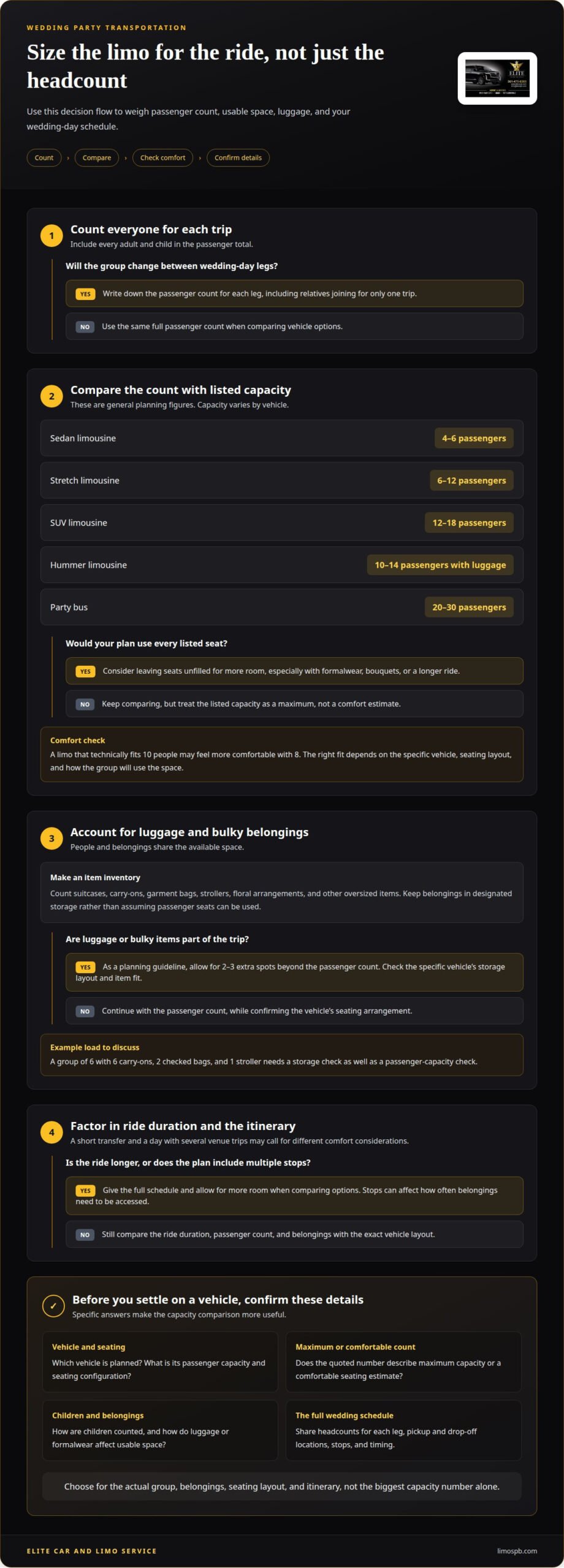
Match the vehicle to your full headcount, seating layout, and wedding itinerary. Listed capacity can narrow your options, but it does not show how comfortable every seat will be.
Passenger Capacity by Limo Type
Passenger capacity is the stated number of people a vehicle can carry, making it useful for comparing limo types. Capacity varies by vehicle, so treat general figures as planning guidance, not a promise about every model.
Sedan limousines are commonly listed for 4 to 6 passengers, while stretch limousines may seat 6 to 12. SUV limousines are described with capacity for 12 to 18 passengers. Hummer limousines are listed for 10 to 14 passengers with luggage, and party buses typically fit 20 to 30.
For wedding plans, compare those options with the actual vehicle being rented. A 10-passenger limo and an 18-passenger limousine represent different group sizes, while the seating configuration affects how that capacity works in practice. The National Highway Traffic Safety Administration standards cited in this guidance identify vehicles holding more than 10 people as buses.
Maximum and Comfortable Seating
Maximum capacity is the highest passenger count listed for a vehicle; comfortable seating depends on how the group will use the space. That distinction matters at a wedding, when formal clothing, bouquets, and a longer ride can make close seating less convenient.
A limousine that technically fits 10 people may feel more comfortable with 8. Capacity figures often describe the maximum, not a comfort recommendation. For a wedding party, compare the full guest count with the ride duration, clothing, and planned stops. Leaving seats unfilled can provide more ease when the schedule includes several venue transfers.
Ask whether the quoted capacity applies to the specific vehicle and its seating layout. A maximum seat count alone does not explain how guests will sit or move inside. Base your decision on the experience you want, not just the largest number listed for a vehicle type.
Counting Passengers, Including Children
Passenger count means everyone who will ride, including children, and giving an accurate total helps match the vehicle to the group. Include each child in the headcount you share when arranging a wedding rental.
Passenger-count rules, including how children are counted, can depend on the stated capacity. Ask whether the figure includes every child and adult and whether the seating layout affects the count. Do not assume a child can be excluded or share a seat.
For example, if relatives join only for the trip to the ceremony, include them in that leg’s headcount. Give the count for each leg if different people ride between locations. This helps ensure a vehicle chosen for one part of the day is not mistaken for the right fit throughout.
Questions for the Limo Company
Before booking, clarify which vehicle is planned, how it is arranged, and how the rental fits your wedding schedule. Specific answers help you compare capacity with comfort instead of relying on a broad vehicle category.
Ask, “What is the passenger capacity of the assigned vehicle?” and “Is that the maximum count or a comfortable seating estimate?” Also ask how children are counted, what the seating configuration is, and whether luggage or formalwear affects the usable space.
Share the headcount for each trip, pickup and drop-off locations, stops, and timing. Ask which vehicle size fits that itinerary and whether the same arrangement works for every transfer. For a wedding party between 10- and 18-passenger options, these details help you assess the right balance of capacity and comfort before committing to the rental.
Allowing space for luggage and belongings
Passenger seats and luggage compete for space, especially on airport transfers and wedding trips. Count both people and belongings before choosing a vehicle.
Luggage and Bulky Item Space
Luggage and bulky items use storage space that passengers might otherwise expect to have. A checked bag, stroller, garment bag, or several carry-ons can change what feels practical for the ride.
Start with an inventory for each traveler. Include suitcases, carry-ons, garment bags, strollers, and event items such as floral arrangements. For example, a group of 6 traveling with 6 carry-ons, 2 checked bags, and 1 stroller has more to accommodate than its passenger count alone suggests. List unusual or oversized items separately.
Keep belongings in designated storage instead of filling passenger seats. This preserves room for people and helps keep the cabin organized. A stretch limo may have a different storage layout from a smaller vehicle, so compare the specific vehicle’s space with your packing list.
Matching Limo Size to Group and Luggage
Choosing a vehicle for passengers and luggage means considering the complete load, not just the seat count. This matters when a group is heading to the airport, traveling between wedding venues, or carrying equipment for an outing.
Combine the passenger total with an item inventory, then consider the trip length and whether people will get in or out along the route. A vehicle that works for a short transfer with hand luggage may feel crowded when passengers bring checked bags and formalwear. The number of stops also affects how often luggage needs to be accessed.
When luggage or bulky items are part of the trip, allow for 2-3 extra spots beyond the passenger count as a planning guideline. For instance, a 10-person group with substantial luggage may need more room than a passenger-only estimate suggests. Compare that load against both 10- and 18-passenger options, without assuming seat capacity equals luggage capacity.
Luggage Capacity by Limo Size
Luggage capacity depends on the vehicle’s storage layout and the size and shape of each item. A passenger count alone cannot tell you how many suitcases will fit in every sedan, stretch limo, or larger vehicle.
For airport transfers, describe the group and luggage together: travelers, carry-ons, checked bags, strollers, and garment bags. Ask how those items fit alongside passengers in the vehicle being arranged. A higher passenger capacity may mean more room, but luggage space still needs separate consideration.
For a comfortable, orderly ride, do not assume that open passenger seats can be used for luggage. Update the item list if the group changes or someone adds a stroller or another bag. This helps match the vehicle to the trip’s actual needs, not just the headcount.
Budget and timeline effects of incorrect vehicle sizing
An undersized limousine can split a group across vehicles, while an oversized one may add cost without improving the ride. Compare the complete guest count, route, trip duration, and luggage before selecting a vehicle. For groups above 12-14 passengers, a larger vehicle can cost less per person, even though its hourly cost may be higher.
Vehicle length also affects where a limousine can load, park, and turn. Regular limousines are typically 20 to 30 feet long, while stretch limousines may measure 30 to 40 feet. Medium limousines are usually about 25 to 35 feet long. These dimensions can influence access at a hotel entrance, event venue, or narrow city street.
Match seating capacity to the occasion and route, not just the guest list. A birthday outing with one pickup and drop-off differs from a wedding itinerary with several stops and formalwear. A larger vehicle may suit a bigger party, while a smaller limousine may be easier to position on narrow streets. Luggage and pickup access matter in both cases.
For a group of 14, compare the actual passenger count with each vehicle’s stated capacity and seating layout. If guests join or leave at different stops, count everyone who rides during each leg. This prevents an early headcount from overlooking later passengers. A final itinerary with pickup locations, stops, and drop-offs also helps align vehicle size with the day’s timing.
Choosing the wrong size can disrupt the schedule as well as the budget. If one vehicle cannot carry everyone, separate arrivals require additional coordination. If a longer limousine cannot use the designated loading area, passengers may need to meet it elsewhere. Share venue entrances and pickup points during planning, since limited space can affect which vehicle is practical.
Super-stretch limousines can be over 60 feet long, so their length deserves attention alongside seating capacity. A vehicle’s passenger count does not show whether it can access every stop on a planned route. For a city event, compare the vehicle’s dimensions with the pickup and drop-off locations. For a venue transfer, account for the route between each scheduled stop.
Before committing to a rental, compare vehicle size, passenger count, trip length, number of stops, and loading access. For example, a 10-passenger group traveling through narrow downtown streets may prioritize access differently from a larger group going directly to one venue. A clear schedule helps keep the choice proportionate to the occasion, while avoiding unnecessary transfers or seating compromises.
How seating configurations affect usable space
A limo’s seating layout affects how passengers share the cabin, even when two models list similar capacities. When planning corporate transportation or a special event, compare the arrangement as well as the seat count.
Face-to-face seating usually accommodates 6 to 10 people. This layout can support conversation, since passengers sit opposite one another. Wrap-around seating can accommodate 10 to 20 people, placing more riders along the sides of the cabin. The difference changes how the group sits together and how much open floor area remains. For a party bus, inspect its layout separately rather than assuming it matches a stretch limo.
Usable space also depends on the shape of the seating area. A wrap-around bench may list a higher capacity, but passengers share its length. Face-to-face seats may create a central area, yet knees and personal items still occupy room. For example, a group planning a special event can compare where everyone sits, rather than treating “10 seats” as a complete description of the interior.
Cabin features can take up space that might otherwise be available for passengers or belongings. Depending on the model, a bar, console, partition, or entertainment equipment may affect where people sit and place personal items. These amenities may suit a celebration, but they do not increase seating capacity. Ask about the layout and consider whether the group values those features more than open space.
Match the configuration to the occasion. On a corporate trip, passengers may value comfortable seating and space for work items. For a birthday or other celebration, shared seating can help guests converse. Formal clothing may call for more personal space than a short ride in casual attire. The same passenger count can feel different in each situation.
Compare the exact vehicle models under consideration, especially when choosing between a 10-passenger and an 18-passenger limousine. Ask how many seats face each direction, where amenities sit, and whether personal belongings share the passenger area. If the group expects conversation, prioritize a layout that supports it. If open space matters more, compare the usable cabin area, not capacity alone.
Seating configuration is one factor in choosing limo size for a group. Review the listed capacity alongside the layout, occasion, and items passengers will bring. A party bus, stretch limo, and other limousine models may arrange seats differently. These details help show how advertised capacity translates into a practical ride for your group.
Choosing a limo for group size
Start with the number of people riding together, then match that count to the vehicle’s seating capacity and trip purpose. For a group of 14, a standard 10-passenger limousine cannot carry everyone in one vehicle. An 18-passenger option may fit the headcount, but the listed maximum alone doesn’t settle the choice. Consider luggage, seating comfort, stops, and how passengers will use the ride.
Think of vehicle selection as a balance of four factors: headcount, comfort, itinerary, and the experience you want. A short airport trip has different priorities from transportation for a celebration or an evening of events. With several stops, keeping everyone together may simplify coordination. A larger vehicle may offer space a smaller party does not need.
Popular vehicle categories give you a starting point, not a universal answer. Sedan limousines are commonly listed for 4 to 6 passengers, and stretch limousines for 6 to 12. Larger limousines can accommodate 14 to 20 passengers. Party buses typically hold 20 to 30, which may suit a group beyond a limousine’s practical capacity. Compare the specific vehicle’s stated seating and layout.
Next, map out who rides on each leg. For example, a 12-person group may travel together to a venue, while only some guests continue to a second stop. Share that schedule rather than sizing every leg for the largest possible group automatically. Include luggage and personal items too. A vehicle suited to passengers alone may feel different when the group brings bags or event belongings.
Amenities can shape the experience, but they do not replace passenger space. If a party bus description highlights features such as a dance floor, ask how the layout affects usable seating. For corporate transportation, consider whether passengers need room for work bags and a composed ride. For a celebration, shared seating or entertainment may matter more; for instance, when planning group festivities like a bachelorette trip, organizers often look to specialized outfitters like Wine Tours of Sedona to coordinate both the itinerary and comfortable travel. Decide which features are priorities before comparing options.
Use this practical comparison when choosing a vehicle:
- Count riders: Include everyone boarding at any point, not only the initial pickup.
- Compare capacity: Review the stated passenger limit and whether it suits the group’s comfort needs.
- Match the occasion: Consider whether airport transportation, corporate travel, or parties shape the priorities.
- Review the route: Account for stops, luggage, and where passengers will board or exit.
For a 10-versus-18-passenger decision, choose the smaller capacity when it comfortably suits the count and itinerary. Consider the larger option when the group size, belongings, or desired space call for it. Plan group transportation around your headcount and travel schedule.
Elite Car and Limo Service: Airport Transfer
Elite car and limo service arranges airport transportation around your party size, luggage, and pickup schedule. Share these details when booking to help plan a suitable ride to or from Palm Beach International Airport.
For private aviation passengers, elite car and limo service provides ground transportation suited to the group’s travel needs. Corporate Transportation For Your Business and Business Travel serve executives and teams traveling between meetings, hotels, and airports. In every case, a clear passenger count and itinerary help shape the reservation.
For airport transportation in West Palm Beach or across Palm Beach County, include the pickup location, destination, group count, bags, and timing with your inquiry. Visit limospb.com or contact elite car and limo service to discuss your transportation plans.
Make the Final Choice With Confidence
Before finalizing the reservation, assign one person to keep transportation details consistent. That organizer can relay updates to the group, coordinate with the event schedule, and tell guests where to meet. A single point of contact can make the transition from planning to travel day more orderly.
Choosing a limo size for a group is ultimately about making the ride fit the experience you want, not simply selecting the largest option. Use your priorities to make a clear decision, then keep the itinerary accessible to everyone involved. For a wedding, corporate gathering, or airport trip, thoughtful coordination supports a more composed start and finish.
For a personal conversation about your transportation plans, contact Elite Car and Limo Service. Share what matters most to your group, and take the next step toward a ride that feels well suited to the occasion.
Frequently Asked Questions
Should I book to the maximum capacity listed for a limo?
Treat maximum capacity as a limit, not a comfort target. A full vehicle leaves less flexibility for personal space, formal clothing, or belongings. Consider how long passengers will ride and whether they need to get in and out at stops. For a formal event, a less crowded arrangement can make boarding easier and the ride more comfortable.
How many people can fit in a limo?
It depends on the vehicle type: sedans are commonly listed for 4 to 6 passengers, stretch limos for 6 to 12, and SUV limos for 12 to 18. Hummer limos are often listed for 10 to 14, while party buses typically fit 20 to 30. Treat these as category ranges, not a guarantee for every model. A vehicle’s own stated capacity is the useful figure for planning.
What limo size should I choose for my group size?
Choose a vehicle that fits the largest number of people riding together, while leaving a comfortable margin for the trip. A 10-passenger limo may suit a group at or below that capacity, while an 18-passenger limo is an option for a larger party. Consider whether everyone travels on every leg. If guests join at separate stops, plan around the busiest part of the itinerary.
What are the differences between a stretch limo, SUV limo, and party bus?
A stretch limo extends a traditional limousine layout, while an SUV limo uses an SUV-style body and may accommodate a larger group. A party bus is generally intended for higher passenger counts. Typical listed ranges are 6 to 12 for stretch limos, 12 to 18 for SUV limos, and 20 to 30 for party buses. Compare the specific layout and purpose, not just the category name.
How much extra room should I allow for comfort in a limo?
For a group traveling with luggage or bulky belongings, allow 2-3 extra spots as a planning guideline. Those spots create flexibility, but they don’t guarantee storage space for every item. Count passengers, bags, garment carriers, and strollers separately. Then describe the full load when arranging the ride, since a suitcase or stroller may affect the usable space differently from an additional passenger.
What limo size is best for a wedding, prom, airport trip, or night out?
The right fit depends on the riders and the trip’s priorities. A wedding party may need room for formalwear and a shared ride between locations. Prom groups should plan around everyone traveling together. Airport passengers need to account for bags as well as seats. For a night out, consider whether the group prefers a quieter ride or a larger shared vehicle, then choose the layout accordingly.
How much luggage fits in different limo sizes?
Luggage capacity varies by vehicle and storage layout, so passenger capacity alone does not show how many bags will fit. Share an inventory of suitcases, carry-ons, strollers, and garment bags with Elite Car and Limo Service, and ask how they fit in the specific vehicle.